Gateway
Gateway is one of Reqable's core debugging features. Despite the name, it is not a network gateway in the networking sense—it refers to Reqable's traffic-control feature.
You can enable the gateway via the menu path Traffic -> Gateway -> Enable (Shortcut key Shift + Control + G). Once the gateway is enabled, an activation icon will appear on the toolbar.
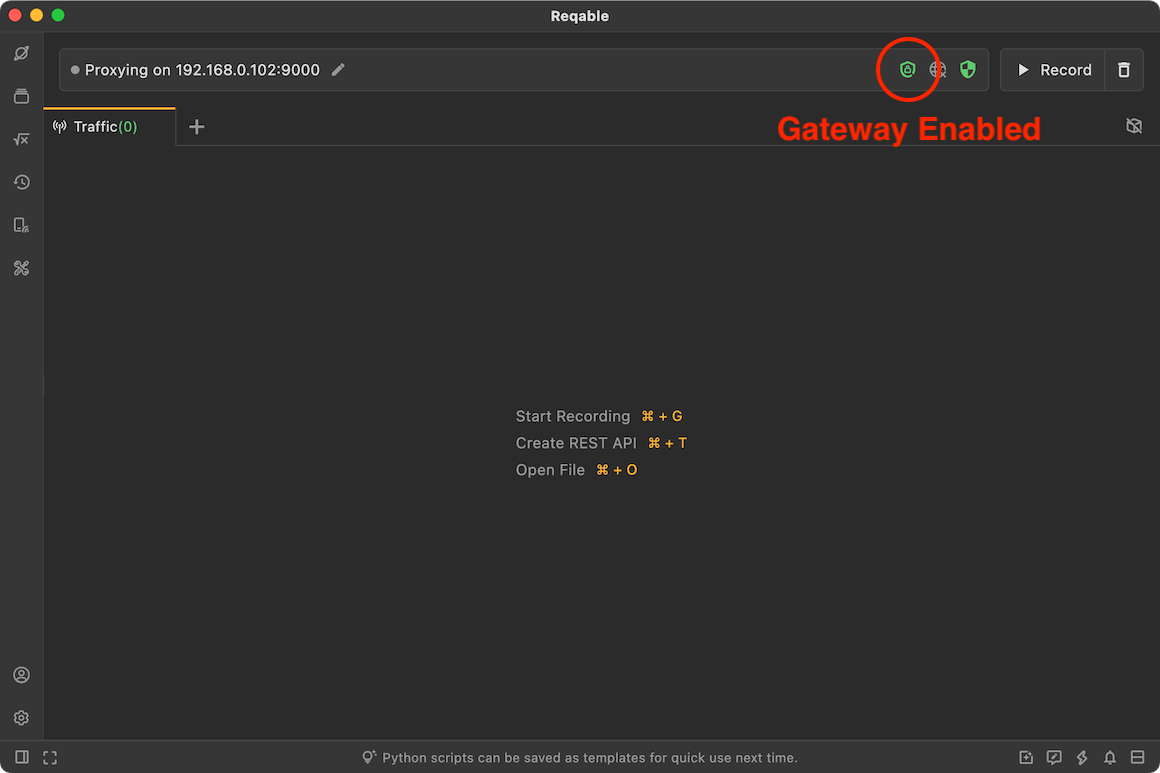
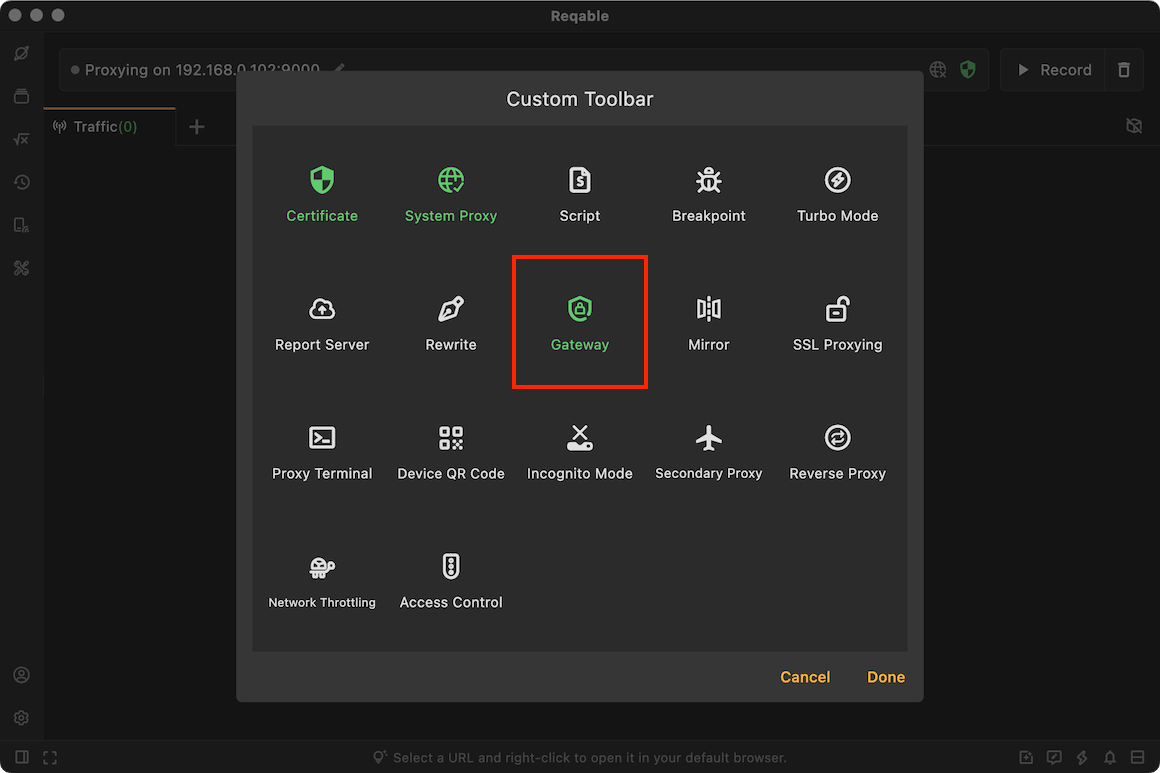
Click the icon above to disable the gateway, once disabled, the icon will disappear from the toolbar. If you wish to keep the gateway icon permanently visible on the toolbar, you can right-click the toolbar to edit and select to pin it.
To prevent abuse, Reqable does not provide this feature on mobile app.
Create Gateway
You can create a gateway rule in several ways:
- Traffic menu -> Gateway -> Add Rule
- Gateway icon right-click menu -> Add Rule
- Tray -> Gateway -> Add Rule
- Gateway List -> New
- Gateway List -> Right-Click Menu -> New
- Traffic list -> Select an item -> Right-click menu -> Gateway
- Shortcut key
Shift + Alt + G
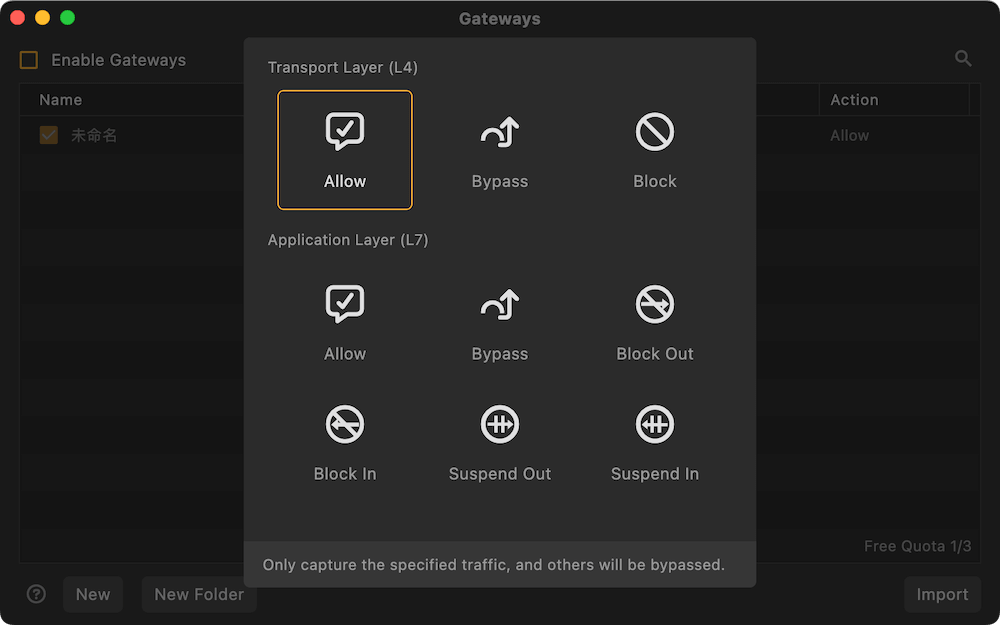
Gateways are categorized into Network Layer (L4) and Application Layer (L7) controls, corresponding to two specific layers within the OSI 7-layer network model.
The Network Layer (L4) offers three modes:
- Allow Only
- Bypass
- Block
The Network Layer (L4) supports two rule types: Domain and IP/CIDR. Multiple rules of each type can be configured, a match on any single rule will trigger the action.
The Application Layer (L7) offers six modes:
- Allow Only
- Bypass
- Block (Outbound)
- Block (Inbound)
- Suspend (Outbound)
- Suspend (Inbound)
The Application Layer (L7) supports four rule types: Domain, IP/CIDR, HTTP, and WebSocket. Multiple rules of each type can be configured, a match on any single rule will trigger the action.
Below, we provide a detailed explanation of each mode.
Allow Only (L4)
At the Network Layer, this mode controls exactly which traffic is captured. Non-matching traffic is subject to a "Bypass" policy (rather than being blocked), consequently, only requests from the allowed traffic will appear in the traffic list.
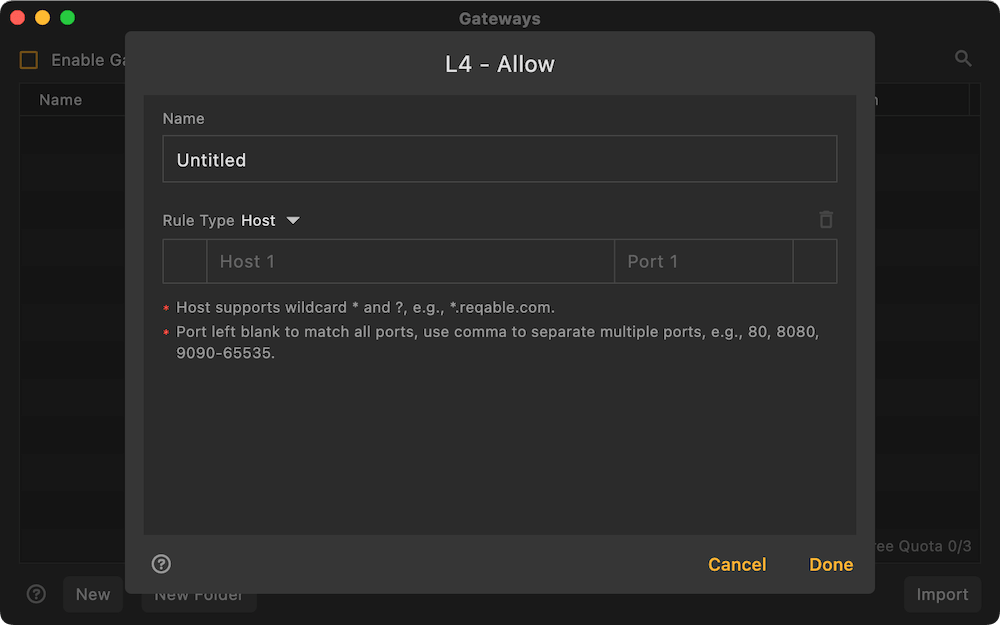
If you wish to block rather than bypass traffic, please create an additional Block policy.
Bypass (L4)
This mode ignores matching traffic, it will not appear in the traffic list, though the traffic itself is still sent to the server. It can be viewed as the inverse of the Allow Only mode. This mode is ideal for filtering out irrelevant requests from the device that might otherwise clutter your view.
Block (L4)
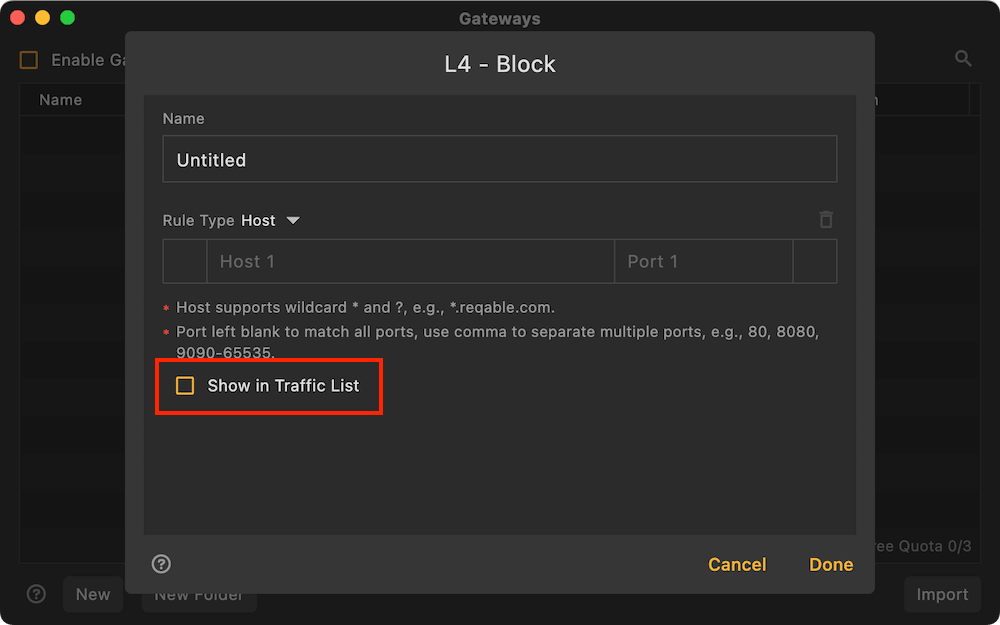
This mode blocks matching traffic, preventing it from being sent to the server. By default, blocked traffic does not appear in the traffic list unless you explicitly check the option Show in Traffic List.
Allow Only (L7)
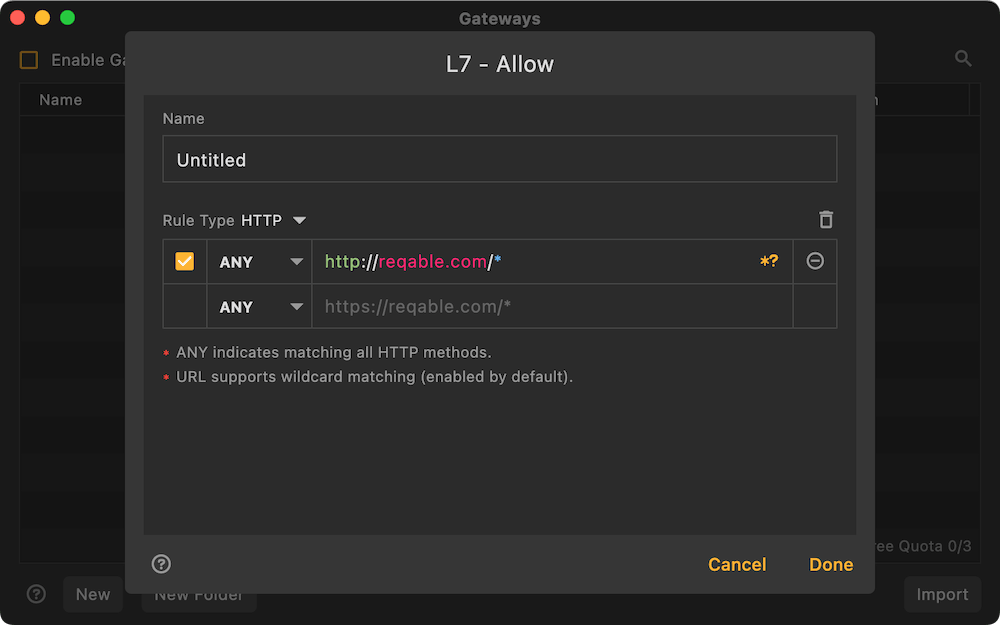
Functionally identical to Allow Only (L4), this mode operates at the Application Layer. Because it processes traffic at a higher level, it enables more granular matching capabilities, thereby adding two additional rule types: HTTP and WebSocket.
Bypass (L7)
Its functionality is identical to Bypass (L4), with the addition of two matching rules: HTTP and WebSocket.
Block Outbound (L7)
Its functionality is identical to Block (L4), with the addition of two matching rules: HTTP and WebSocket.
Block Inbound (L7)
In contrast to Block Outbound (L7), this rule blocks traffic sent to the client, rather than traffic sent to the server.
Suspend Outbound (L7)
In contrast to Block Outbound (L7), Suspend does not terminate the connection, instead, it simulates a timeout effect.
Suspend Inbound (L7)
In contrast to Block Inbound (L7), Suspend does not terminate the connection, instead, it simulates a timeout effect.
Processing priority for a single request that matches multiple modes: Allow Only > Bypass > Block > Suspend.
Rule Management
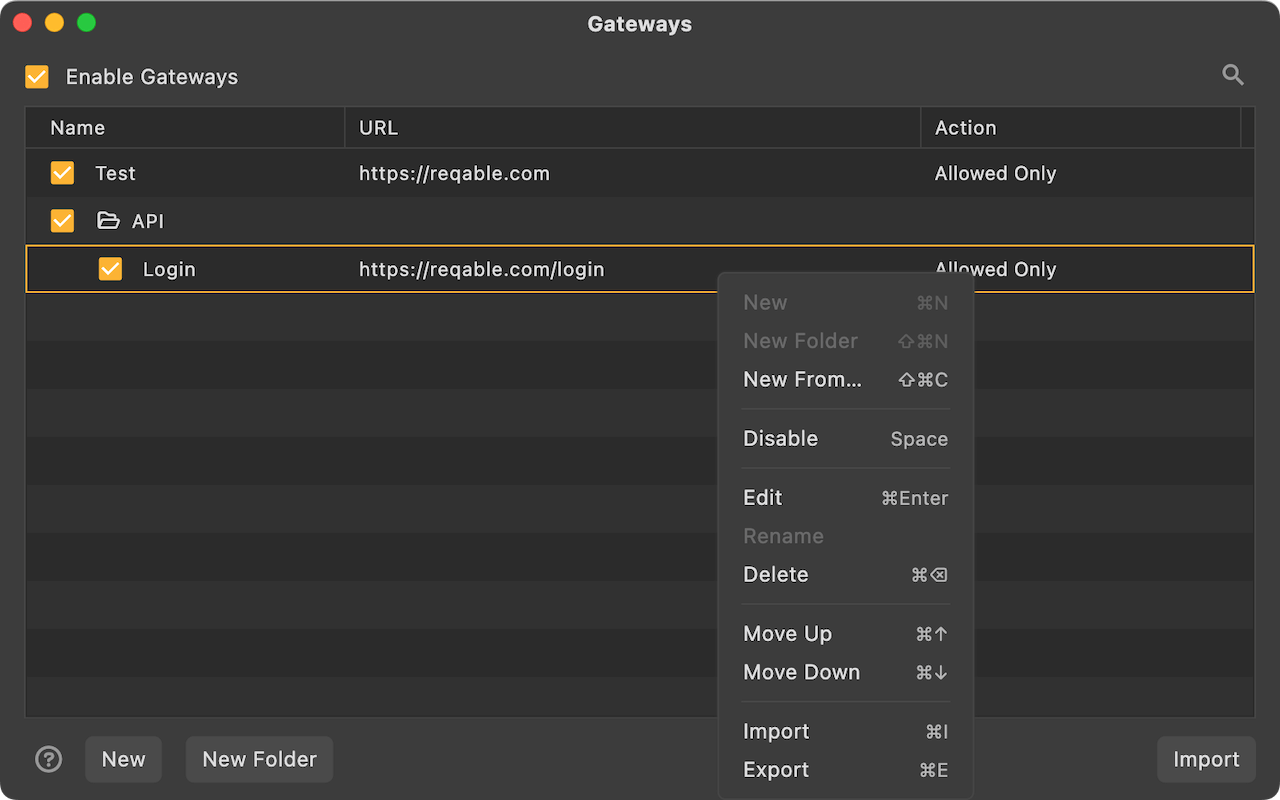
Rules are matched from top to bottom. The same request can match multiple rules. The one at the front will be executed first. Rules support folder-level management. You can adjust the position by long pressing and dragging. Import and export are also supported for sharing rules with others.