Filter and Search
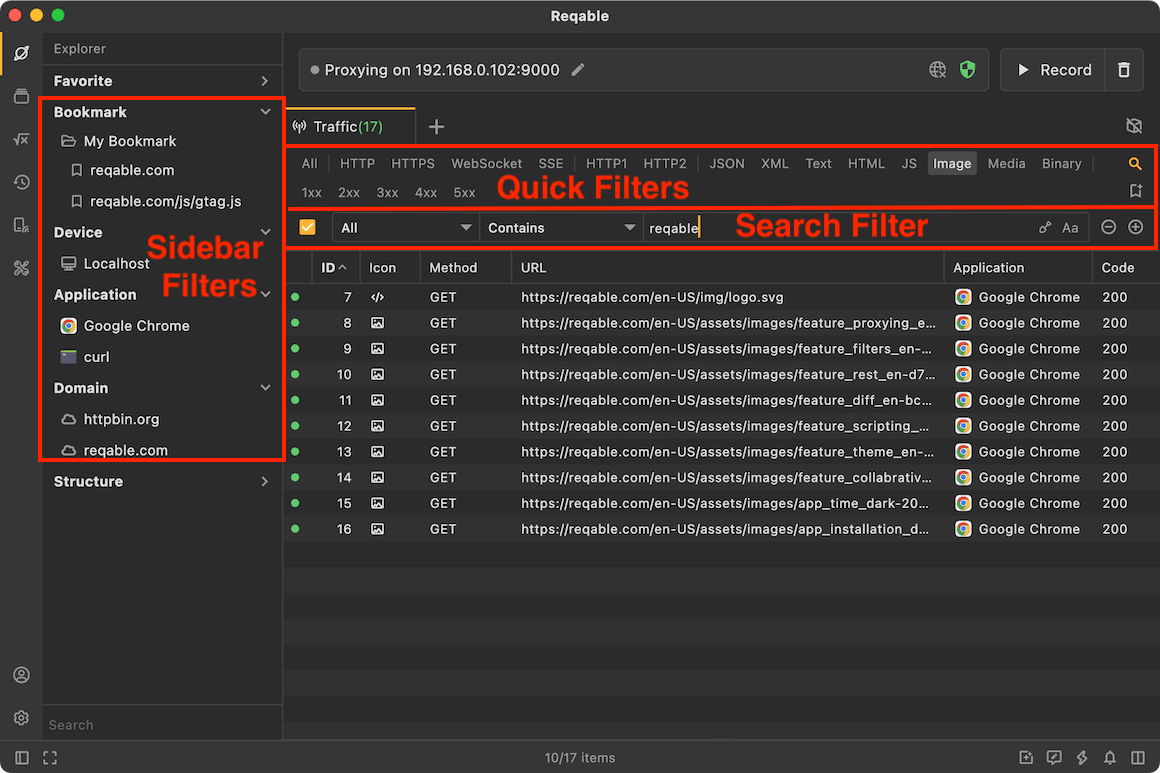
Reqable offers a diverse range of data filters, specifically: Bookmark, Device, Application, Domain, Quick Filter, and Search Filter. Among these, Bookmark, Device, Application, and Domain are located in the Explorer sidebar, while Quick Filter and Search are situated at the top of the traffic list.
Bookmark
Bookmarks are used to quickly filter requests, clicking a bookmark filters the list to display only matching records. Bookmarks support multi-selection, applying an "OR" logic when multiple bookmarks are selected.
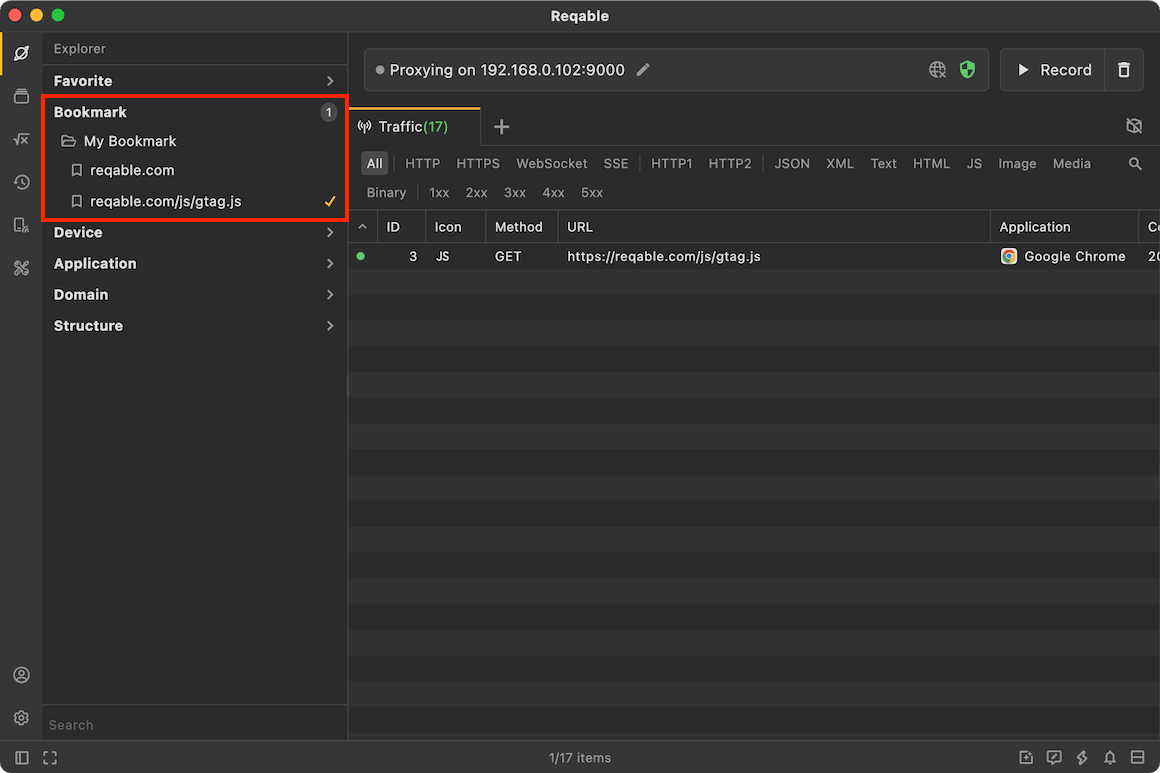
Bookmarks are managed using folders (which support only a single level of hierarchy). You can create a new bookmark by right-clicking on a folder. Additionally, you can create a bookmark directly from Traffic List.
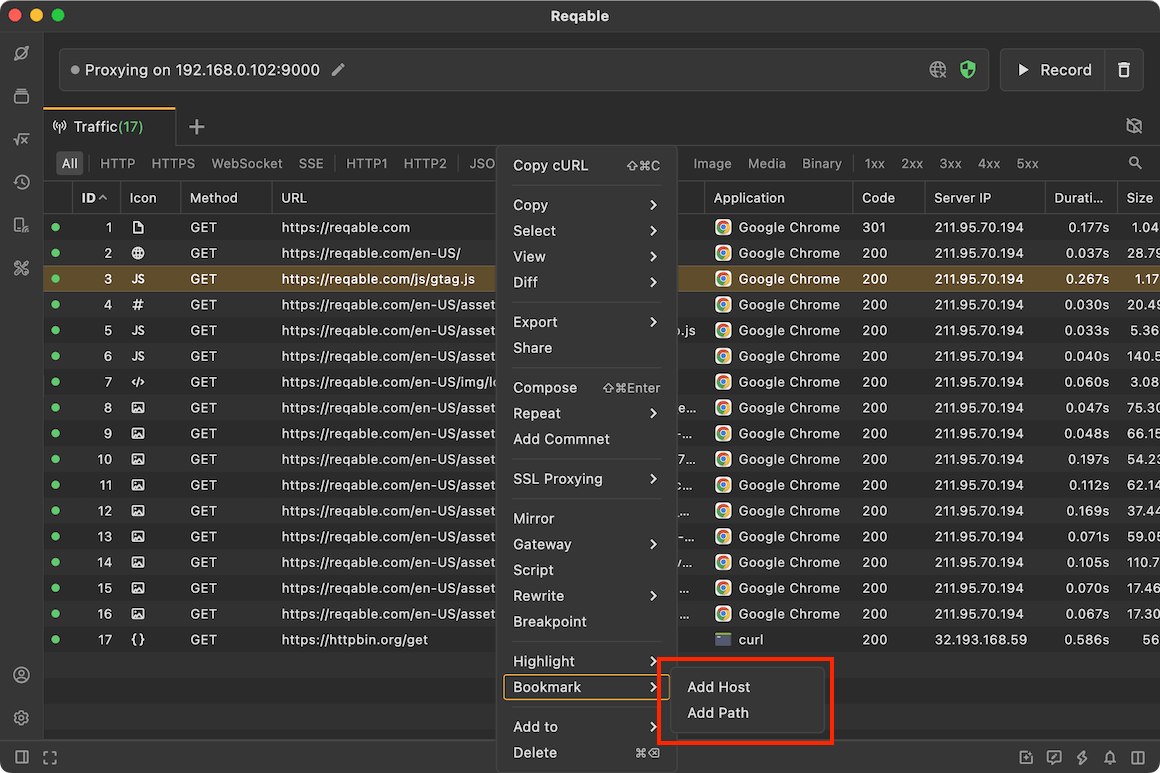
Reqable includes a built-in "My Bookmark" folder by default; you can also create your own custom bookmark folders.
Device
This feature is used to quickly filter records and operates according to an OR logical relationship with Bookmark. The explorer displays the names of all devices in the list (if connected locally in non-Collaboration, the source IP address will be displayed instead), users can select one or more devices to filter the results based on their specific needs. If no devices are selected, the list will display all devices.
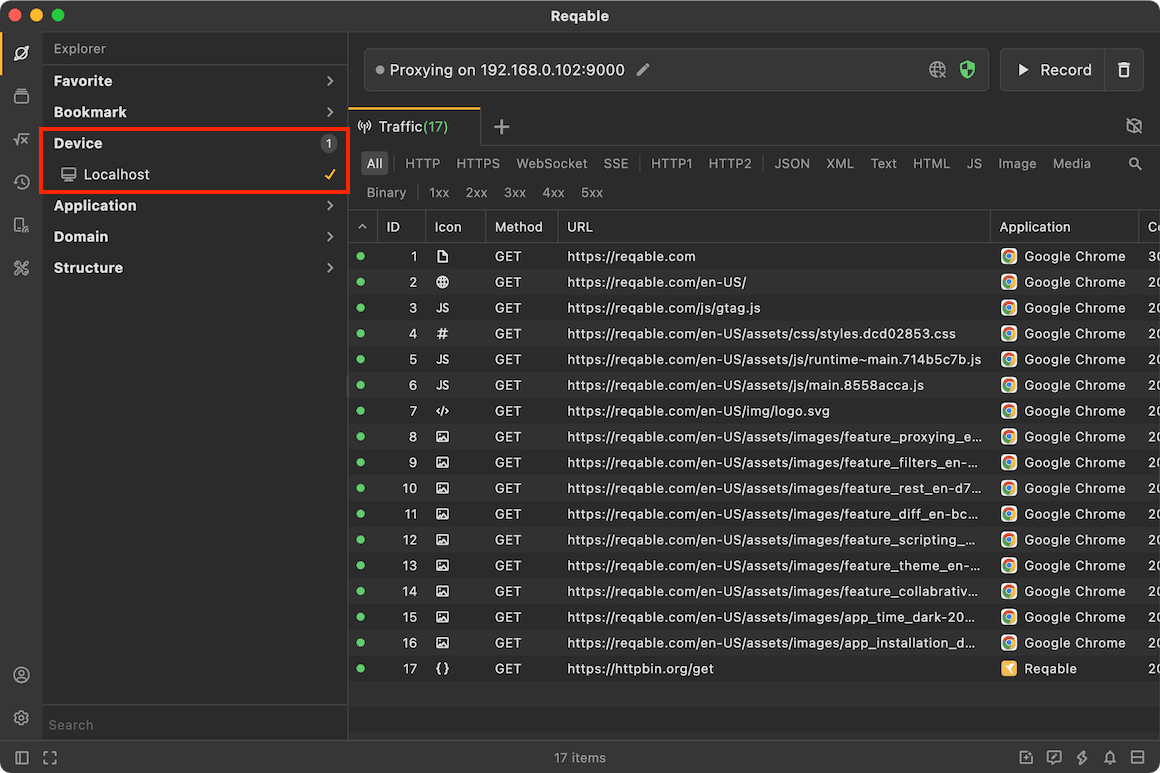
- Double click to single select.
- Click on a number to deselect all.
- Right click to pin the device to the top and keep it there.
Application
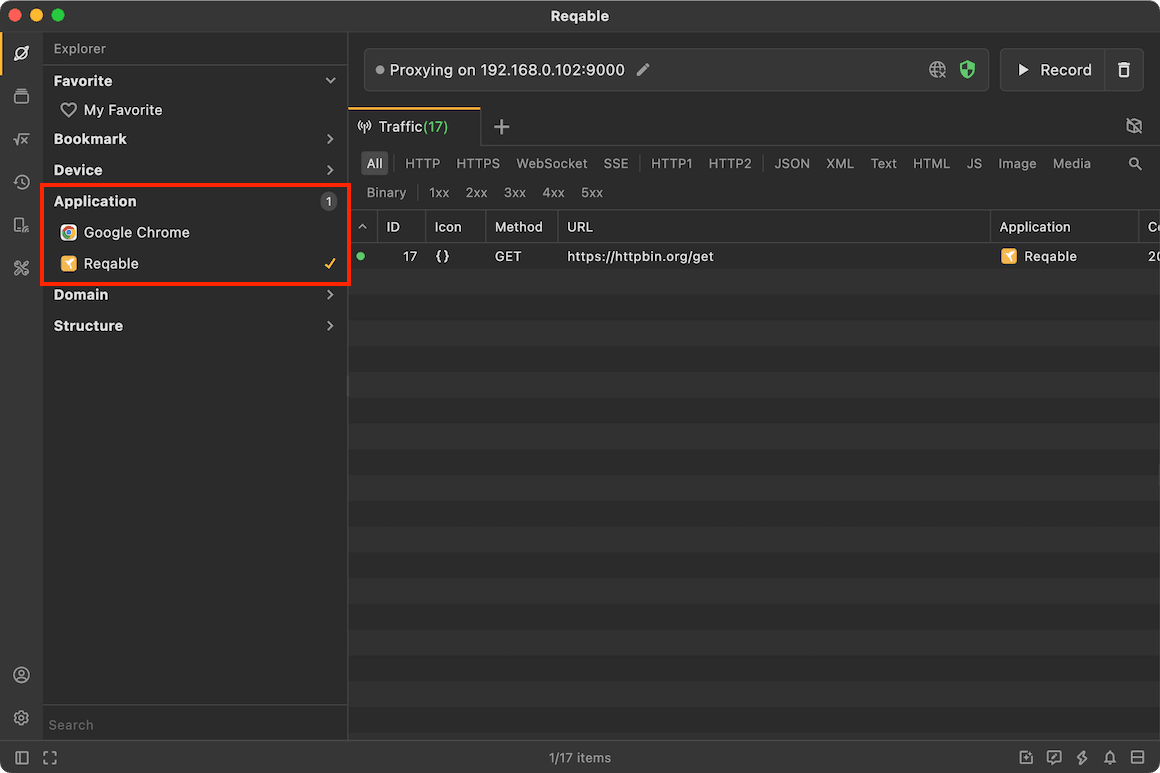
Application is used to quickly filter records, and has a logical relationship of OR with Bookmark. All applications in the list will be displayed (traffic without detected application source will be displayed by Unknown App). You can select one or more applications for filtering. If no selection is made, the list will display all applications.
Domain
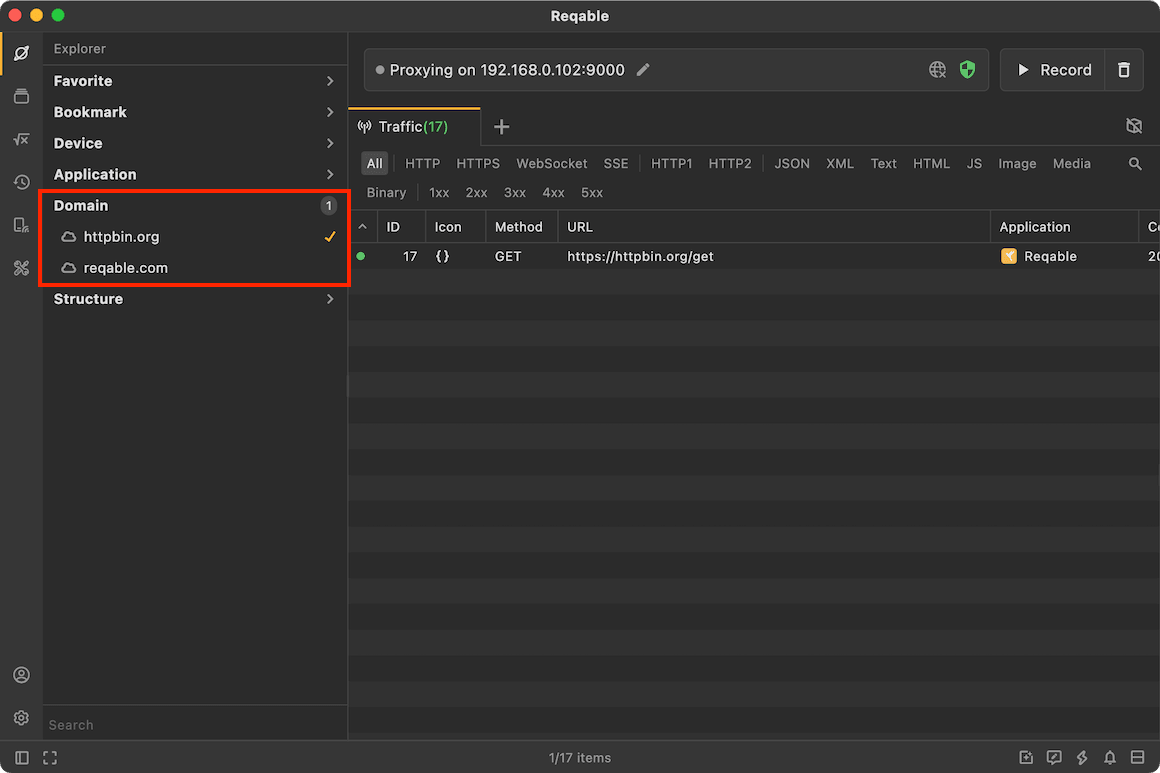
The domains are also used to quickly filter traffic, and can be used together with bookmarks using OR logic. All domains in the list will be displayed in the explorer. You can select one or more domains for filtering. If not selected, the list will display all domains.
Quick Filter
The quick filter is located at the top of the list and is divided into three parts: protocol, content type, and status code. Filter items in different parts can coexist, and the logical relationship is and. Click each filter item to quickly filter, and click again to cancel the filter.
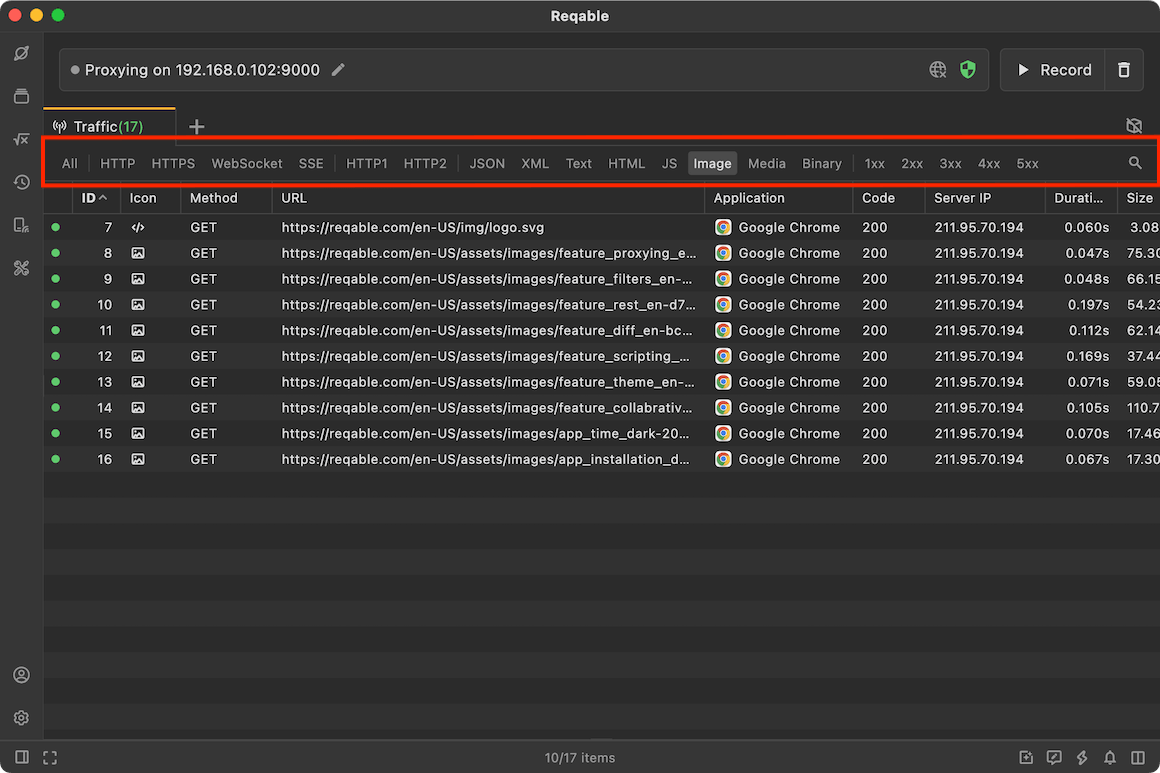
1xx, 2xx, 4xx, etc. represent the status code range, for example, 4xx represents the range of 400-499.
Search Filter
Reqable provides up to three sets of search conditions, and supports global search and subdivided search. Click the magnifying glass button on the far right of the quick filter bar to open it, or use the shortcut key Control + F to open it.
Supported search criteria include:
- All
- URL
- Method
- Request Mime
- Request Header
- Request Body
- Response Mime
- Response Header
- Response Body
- Code
- Remote Address
- Local Address
- Highlight
- Interceptors
- Comment
- Console
Supported search match types include:
- Contains
- NOT contains
- Equals
- NOT equals
- Starts with
- Ends with
- Match wildcard
- NOT match wildcard
- Match regex
- NOT match regex
Reqable free users are provided with one set of search conditions, while premium users are provided with up to three sets of search conditions.
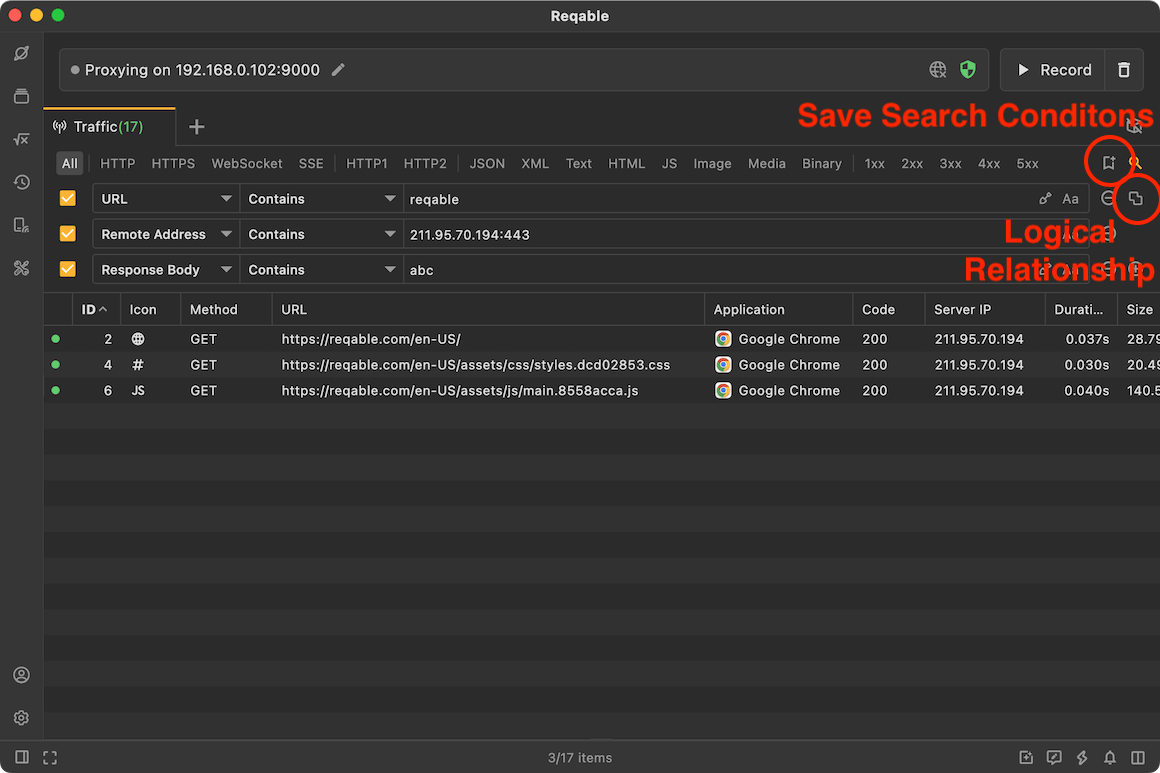
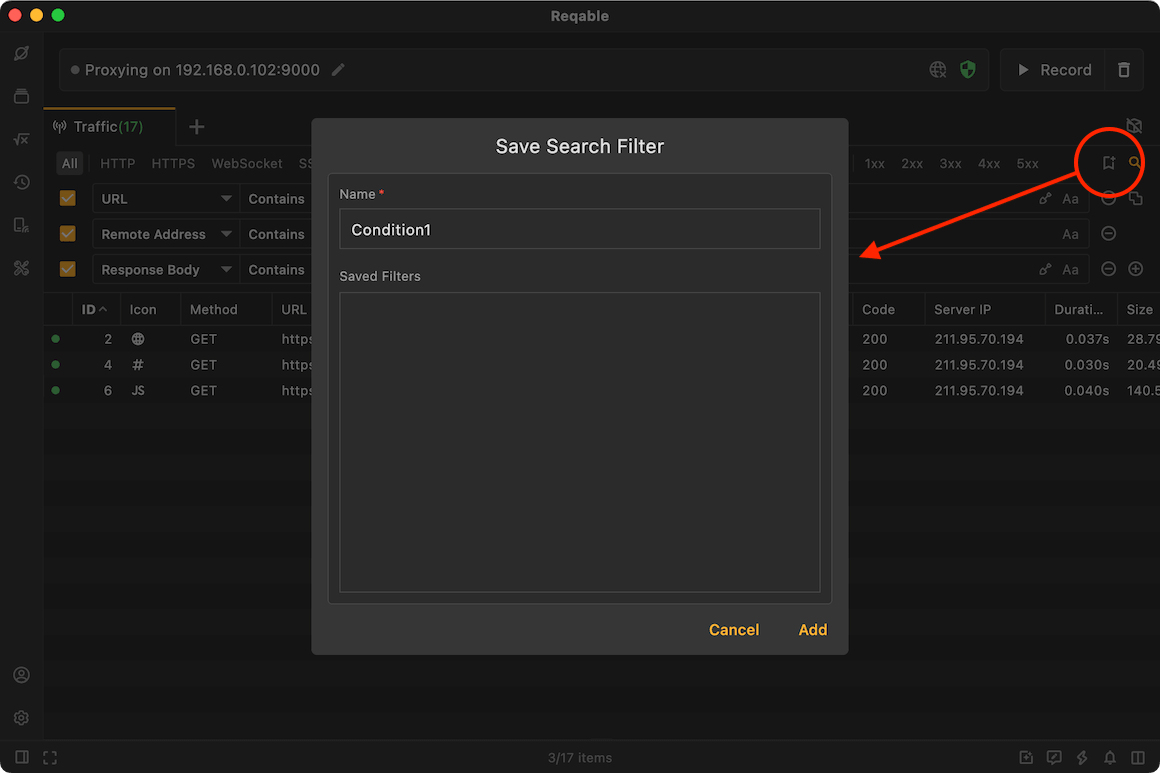
The logical relationship between each set of filter criteria defaults to "AND". However, you can click the icon shown in the image above to switch the logical relationship to "OR." Clicking the "Save Search Filter" icon in the image allows you to save your current filter settings. Saved configs appear in the Quick Filter, allowing you to apply them directly with a single click in the future.
Some non-ASCII characters such as Chinese are encoded using Unicode. By default, for performance reasons, Reqable's search filter does not decode these characters back into their original text form for matching purposes. If you encounter this situation, please enable Deep Search (indicated by a shovel icon located at the end of the input field).